





Questions for misandrists and misogynists
Does your ideology stem from pain?
Does your ideology cancel out one-gender identifiers or post-gender identifiers from being well?
Does your ideology have compassion for the pain and will-to-life of others?
Is your ideology involved in enabling the wellbeing of more-than-human life?
Is your ideology enabling the society you identify with to flourish?
Is your ideology aimed at freeing children of reductive forms of society making?
Does your ideology seek love or hatred as your preferred mental nourishment?
Terra Nullius Breakfast, Daylesford (a relatively new tradition exposing a fairly old lie)
Friday, February 1, 2019
Something I'm proud of establishing recently is the annual Terra Nullius Breakfast in my home town, utilising shame as a creative force to actuate a new story – that is, being in attendance collectively to acknowledge the grief and trauma caused by this simple Latin legal signifier, which continues to swim in its violent semiotic across the continent.
 |
| Terra Nullius Breakfast, Daylesford. January 26, 2019 |
 |
| Terra Nullius Breakfast, Daylesford. January 26, 2018 |
 |
| Terra Nullius Breakfast, Daylesford. January 26, 2017 |
Across the nation-state of Australia today, across all the terra never ceded that constitutes this nation, Australian schools continue to obscure the historical fact of terra nullius.
Read more...
Rifkin's sale pitch is a leaky vessel (not a road map for the future)
Tuesday, December 18, 2018
Compelling at first, a neoliberal Baby Boomer unpacks the horrors of the first two industrial revolutions, then amazingly offers us a third, requiring even more extractions. This, Jeremy Rifkin claims, is a "sharing economy." The manipulation of 'sharing' here is interesting to note. Governments and big businesses are requiring their subjects to become greater actors for two reasons: to share the responsibility of maintaining endless growth on an evermore finite planet, and to share the responsibility for the consequences of such economic idiocy.
This beautiful essay, Magic and the Machine (prepared as a podcast), can be considered an apt critique of Rifkin's fantastical Third Industrial Revolution managed by an autonomous and tumorous Internet of Things. But unlike Rifkin's sell, David Abram's is not a simple fix, it requires deeper listening, contemplation and a radical decoupling from salesmen.

Read more...
Trash news vortex (updated)
Wednesday, October 24, 2018
I could start my critique of this New York Times story with this image.

Looks profesh and serious, doesn't it. The font says, trust us, the photo brewing and mysterious. Seductive even. But it would be more honest to begin it like this.

The story, written by journalist David Maurice Smith (who also took the pics), begins with a pop out ad directing readers to SHOP NOW. We're not sure if Smith photographed the felted slippers too, it's not clear, but probably not. Smith's story travels along as a children's tale, identifying the perps "likely from Indonesia" and those who are being rescued "including sea turtles, dugongs and sharks."
The nature of this fly in fly out journalism and the publishing realm it sits within seeks to sever the connection to the real perpetrators of this story – neoliberals who SHOP NOW, eat supermarket fish, buy their goods in plastic, and fly and drive around the world to see 'great' art.
While preparing this little post, which could be applied to any article appearing in any ad-funded news media, the title and title ad changed to this.

Fossil fuelled consumption is the great missing character in this story, consumption perpetuated by the world's rich who consume such media. Comfortable slippers and opera are the main events in the environment of the NYT online, a story about an Aboriginal mob's cleaning up of imperialism's wastes is just the fill.
To finish with a pretty picture...

Who gets to critique? Examining Mike Jay's Who gets to trip?
Saturday, October 13, 2018
Listen to Mike Jay's critique of Michael Pollan's How to Change Your Mind.

I think Jay makes a case in the end. However, from the point of view of someone who has read Michael Pollan's book, it appears he skim read it, looking for fault like a jealous co-reporter in the field. Jay's defensive skimming produces at times notable absences that could have strengthened his argument by citing a few key moments where Pollan unwittingly reveals his remarkable privilege (for example, his guided solo trips equating to hundreds of dollars, both flown and drove to like we're living in a time of endless oil and such finite resources are innocent and non-harming, could have been incorporated). But counter to an argument concerning privilege, there are many places where Pollan could easily attend to Jay's critique, as the latter misrepresents, collapses and generalises what has been researched (broadly) and what has been written (by Pollan and others). Jay's argument, finally, is worthwhile, for who in the future will be afforded a trip? but perhaps for naive reasons. Jay comes from a structuralist medical position, which goes something like: most people are victims of modernity, they are sick and they need taking care of. He is, for example, more concerned that Big Pharma won't be able to sell psychedelics (due to their unpredictability) than he is with the fore place of an imperialist-modelled pharmaceutical industry in society. A critique of the business model of pharmaceutical companies is absent here, like we should all go along with predator-capitalism where keeping people unwell with industrial food and medicine is key to the growth of these industries like privatised prisons grow numbers of prisoners. It's as though Jay believes industry-science is worthy of our continued blessing. As someone who rarely pays for his food and medicine, because it either comes from a garden ecology or a commons where foraged mushrooms (psilocybin and culinary) and the drawing on a great pharmacopeia of weed medicines are gathered for preventative reasons, Jay's argument has blind spots. It sits well within a somewhat smug urban realm of the LRB community, but it doesn't recognise the unavoidable fact we are all operating from an ideological place, which especially reveals itself when we set out to dismantle another's argument, as I have done here. Carbon privilege blind spotting extends to all of us who use the internet – the great polluter. Though tripping on dopamine hits from social media is nothing like brewing in a billy a tea of walked-for mushrooms, wattle and blackberry leaf and entering the imaginal realm of a creek-side ecology. Read more...
The single global project for the Left (protection of local interbeing, commons, oikos)
Thursday, September 27, 2018
Frankly, I wouldn’t like to live in a stupid society where I would have to be all the time engaged in local, communitarian politics, and so on and so on. My idea is to live in a society where some invisible, alienated machinery takes care of things so I can do whatever I want. Watch movies, read and write philosophical books and so on... The problems we are confronting, we can list them in differing ways, but my point is they are all problems of commons. For example, ecology is clearly a problem of commons. Nature or natural environment is our commons, something that shouldn’t be privatised because it belongs to all of us. It is the background, literally the ground of our being. And it’s clear for me here we need to, erh, we need to reinvent, not local democracy but on the contrary, also large-scale solutions. The problem today is not local, not local communitarian democracy, the problem today is how [to] regulate trends worldwide.
Slavoj Žižek: Democracy and Capitalism Are Destined to Split Up, Big Think, published on Jan 7, 2015
While Slavoj Žižek’s idea for communism is sensibly rooted in engagement with a present commons rather than dwelling in the failed communist projects of the twentieth century, his thinking here reveals deep conceits. What commons, who is labouring them, how are global human needs met without negating the call of local human and biotic others?
Žižek expresses himself with an anthropocentric-bourgeois worldview typical of many urban intellectuals – to live in a society where some invisible, alienated machinery takes care of things so I can do whatever I want. By urban here, I do not mean people who necessarily reside in cities, but rather people who are constructed or crafted by a hyper urbanised world making, or what I’ve called hypertechnocivility – human-centric institutionalism, machine dominance and extreme domestication. Within this limited place for thought there is little listening to the call of biotic others, and few lived examples of a truly shared world. World, to Žižek, must submit to the philosopher’s longings, which for him can be provided by large top-down solutions and alienated, world-destroying distribution systems to bring him his basic needs and comforts – movies and books and so forth.
Žižek’s project could be to speak of the codependency the local and global have with one another, but the local is perhaps too much too close for an ideas man. The 'local' demands relationships and listening much more than blowing ideas. With Žižek, ancestors and nonhumans are of course all relegated to the metropolis’s androgynous dump sites because alienated automation demands such consciousness. Any talk of making returns - regressions, digressions, decays and unmakings – brings scorn and accusations of noble savagery, romanticising indigeneity, pathetic fallacy, the typical attacks from urbane intellectuals on the Left and Right. In Žižek’s alienated city, wholly dependant on extraction and transporting in far away resources, no returns can be made, biophysically or culturally. Everything is a waste stream. Linear progress capitalism (free marketism) and linear progressive urbanism (identity politics) reveal a dim, almost nothing divider between Right and Left, funded by cheap crude oil, rolling out endless footpaths of domestication and monospeciesist thought. Essentially, both advance the global destruction of the planet in their very alienated linearities.
This is why Žižek gets attention. He’s good for the Right, so improbable and incoherent is his philosophy albeit clever and a novelty voice to spar with, and for the intellectual Left a relief there is a counter spokesbeing getting as much attention as Steven Pinker and other apologists for Enlightenment-triggered economic ruination of the biosphere. But really they are the same mens of their generation who lack any abiding care for the relationships required and laboured with within each local ecology. Žižek and Pinker et al are products of selfish-gene ideology, of a carbon-privileged educational training system. Ironically, the mother, mater, is null and void to such materialists. But declining oil deposits and other significant materials that have made the monster, Globalman, and which provides such grandiose illusions – bring me my movies and books, and while you pass the fridge grab me my originless, earth-destroying food – is a momentary affair with ancient sunlight and ancient bird shit. Yes, we’re also at peak phosphate rock, a critical ingredient of alienated agriculture – the brain fodder of hypertechnocivilians, Baby Boomers the first total alpha generation.
There is, however, some place of commune with Žižek in addressing privatised intransigence and exploitation of the biosphere’s innumerable commons. But contrary to Žižek’s boredom with the relational and listened-to local, the only global political project worth considering for the global Left (after it's done with its compulsive obsession with city focussed, carbon-privileged identity divisiveness) is the dismantling of the globalised destruction of local communities and environments. That is the globalised protection of infinite local environments, people and biotic others. If Žižek has a political project that addresses the problem of a systemic eradication of world commons, then there is coherence here. This inevitably must include the degrowth of money and the growth of relational economies, returning to localised gift economies between trusted kin and more formal barter with community others. Money can serve the realm of strangers and enemies, which needs to be no more than 30% of each local economy, which in turn pays for the global culture to protect from violence any local culture. This of course is the dissolution of the banks and debt-based finance.
Until local communities – biotically diverse cultural communities – can make the call on behalf of their local biomes there will never be a proper addressing of species extinction, climate change or resource depletion, never a propper addressing of systemic pollution ideology so required for Žižek’s movies, books and alienated food and energy resources to be trucked to him from someone else’s commons.
The vast global project of local commons protection requires a rebirth of a politically loaded re-indigeneity, especially with regards to how we make economy and how we live with fellow species. This understanding is not possible as hypertechnocivilians. The global Left requires non-urbane voices to be listened to, human and biotic others, to work stridently beyond the frames and limitations of hypertechnocivility. The city universities of the world are generally too narrow in their scope to bare an intelligentsia required to mount the logic and scope of a deeply listened-to global ecosophy stating the protection of local biomes. Economy must return to a loved homeplace, replacing systemic militarised automation with biotic intimacy and the making of returns - gifts. The global project of the Left is to see to it that this is made possible. Everything after this vast project, if fulfilled, becomes a local matter – a return to relationship with each local mother.
Read more...

Can a poet speak on economy?
This week I gave a talk as part of the La Trobe University Art Forum lecture series about how my solo work found its way into the all encompassing collective practice of Artist as Family. What happens when artists cease to be co-opted by an industry enframed by the imperatives of capital and augment new economic narratives? A radical-homemaking, permacultural-neopeasantry springs forth!
If this post has turned up in your inbox as an email subscription you won't be able to see this video.
Read more...
Permacultural neopeasantry and people care
Sunday, July 1, 2018
Here is my Melbourne Free University (MFU) talk, in video (audio) form:
If you're reading this in an email, you'll need to click through to see the link.
A few thoughts since I gave this talk, where I became the subject of an unproductive ambush:
While the Left attacks itself over technicalities, different lifeways and language use – the very things that herald the potential for diversity – the Right runs away with the ball, laughing hysterically all the way to the banks. How we treat one another is key to a transition from dominating power relationships that aim to hurt and divide and towards a culture of true diversity.
The most destructive part of question time in my MFU talk was the product of a few people coming to the gathering with a will-to-violence that disallowed the possibility for deep listening. This is how violence establishes itself, it feeds on reductionism.
I wrote about the project of people care in Perma/Culture: Imagining Alternatives in an Age of Crisis. My chapter is called Reclaiming accountability from hypertechnocivility, to grow again the flowering earth (you can read it below), and it outlines approaches to understanding how violence, especially in language, be it privileged or retaliatory (or somewhere on the hierarchical scale), is a force for the destruction of the other who is not living our values. The ecological ramifications for humans endlessly attacking one another are of course innumerable. Business thrives on such hatred, which in turn creates assaults on ecology because consumption often ramps up when people are unsettled, shamed, angry, desperate or self-loathing.
To include the potential of the other in one's frame is a practice of understanding through deep listening. Buddhists and others might say it's the heart where compassion resides, but it really seems apparent now that the relationship between the enteric biome (of the gut) and the cortex-limbic biomes (of the brain) are where our social selves speak and act from.
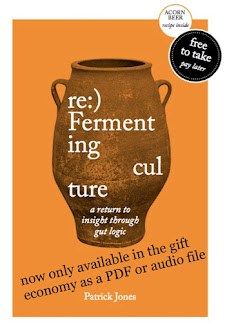
re:)Fermenting culture (audio version)
Saturday, June 30, 2018
I have recently recorded re:)Fermenting culture: a return to insight through gut logic

as an audio book.
Poetics permaculture biomes and death
Friday, June 29, 2018
An excerpt from a talk I recently gave in Geelong...
You can watch the video I refer to here.
Read more...

Permacultural neopeasantry in the burbs
Thursday, May 10, 2018
I have a forthcoming (May 24) talk in Melbourne as part of MFU's program. It would be great to see you there and join the discussion.
Modern Australia (in its very linearity) is a melting pot of cultural diversity forever being homogenised in an obsessive pursuit of progress. Neoliberal modernity lauds its one solution; one economy agenda, which is the shocking process of cultural, biological and economic pasteurisation that follows in the (gender-lopsided) footsteps of reductive science, social Darwinism and classical political economy. Peasants first, then First Nations people were labelled sloths and lazy by pundits of a so-called moral philosophy. Yet, for many of us, our old people (before the dispossessions, ecocides and genocides) lived carbon-positive lifeways and with intimate connection to earth processes. Acknowledging this past and drawing on it seems like a matter of pragmatic resilience more than moral altruism or romantic/political wishfulness. In an era of climate change (digi-industrial capitalism), ecological illiteracy (aggregating urbanisation), greater social divisions (reinvention of class relations), and human population explosion (chronic species loss), what stories and what lifeways can we action within the household and community economies? Patrick Jones (from Artist as Family) – living a neopeasant economy through the application of permaculture principles – offers not one solution, but a microbially-rich suburban response to the complex predicaments of our time.

Read more...
Ruffling the feathers of KeepCup scholarship
Thursday, April 19, 2018
Against ‘neo-peasantry’ and the desire for self-sufficiency, an article recently written in Overland, misses three crucial points: Neopeasantry concerns community-sufficiency, an abiding connection to ancestry, and modelling carbon positive futures. These three things have been crudely disappeared by Rachel Goldlust in this polemical writing parading as scholarship.

Here is the reply we posted on the Overland site:
Hi Rachel, we are that family from Daylesford you mention. We would have been open to being interviewed, even a visit, it’s a pity you only refer to a new.com.au article as your main reference to us.
In this writing you attempt to disappear our ancestors. Of course, ‘neo’ locates our ‘fessed up privilege in choosing to be peasant-like, but ‘peasant’ is our heritage, our families, our pre-industrial past prior to the enclosures and the ‘primitive accumulation’ of our ancestral lands.
There is both an everyday intimacy and lived-politic that we’re advancing by championing this term. Our politic goes like this: If people can again have access to land they can produce alternative, land-conscious economies. They can decouple themselves from the giant wrecking ball global economy and potentially live a carbon-positive lifeway. We are modelling this politic every day.
We don’t deny we’re on Dja Dja Wurrung country, we live that reality. We also don’t deny our own indigenous-peasant past and we draw on it to transition from what we call hypertechnocivility.
Ultimately, we are neopeasants who apply permacultural principles to our home and community economies to further become accountable mammals of place, and this constitutes our practice of art, our culture making and our corporeal forms of feminism.
Your article strikes us as another act of urbane violence directed at an imagined and clearly poorly understood target. We question your scholarship.Read more...
Nuts, pulses, grains and fruit, KILL BIRDS!
Friday, February 16, 2018
The title for this post is a line from a neopeasant folk-punk song I recently wrote, which harks back to what I discovered in my doctoral research: that the production of nuts, pulses, grains and fruit require the wholesale killing of wild birds. No food, I have argued in many places before, is ethical if it is commercialised because money asserts a special kind of pressure on life that non-monetary gardening, farming, hunting and foraging does not. Business indebtedness to the money system applies an incalculable pressure on ecologies in order to guarantee the crop or harvest does not fail. If this means gassing, poisoning and shooting wild birds then that is what occurs, and my research has found this takes place on the smallest commercial farm to the largest. Various government agencies produce research surveying which wild critters negate monetised agriculture, such as this one. And this recent newspaper article demonstrates once again that commercial "vegan-friendly" food doesn't really exist.

Despite what members of the Australian Food Sovereignty Alliance and others might espouse there is no ethical meat in Australia that is bought, and despite what militant vegans might advocate there are no ethical nuts, pulses, grains and fruit either. Food that isn't under monetary lock and key has a greater opportunity to be produced in relationship with the broader biome. Like many food industries including almond, peach, fish and pork, countless species (and relationships) go to waste in order to procure the one desirable harvest or produce one specific crop. This is the monological nature of monetised food. Of course, food labelling is so poor in Australia few really know what they're eating and certainly less know of the biome harm that is done to produce food.
To bring this story home, we neopeasants net and scare off wild birds from our fruit and nut trees, and occasionally kill the odd raiding critter, which has the effect of deterring others. However, nothing of this taken life is wasted and with such lovely fruitarian flesh we make more life possible. For us all is food, all is life, all is the exchange of energy and matter from one form into another. Money corrupts this relationship and constructs wasteful industries. The so-called ethical food movement needs to radicalise and transition to non-monetary economies if we are to attempt to stop species decline, climate chaos and anthropogenic violence on the earth.
While this may seem crazy to suggest in a certified capitalist society, viewed from the context of money's assault upon the living world (from small business to big), we have to start thinking whole-biome culture, which essentially requires macrobiome economy.
Read more...
Radical economy making - the imperatives of productive home economies for the reestablishment of ecological cultures of place
Monday, February 12, 2018
In this video I present a case for the home economy as the primary place from where ecological culture is remade, reclaimed and re:)fermented.
It is an excerpt from a talk I gave in Ballarat last week, with a surprise cameo appearance. Watch this video, listen to it as a podcast, and check out this quote from Shannon Hayes, redefining wealth and poverty:
For the Radical Homemakers, wealth and poverty are determined by a different paradigm. One of the first determinants of "impoverishment" was a lack of personally "owned" time – life-hours lost to participation in soul-sucking work pursuing excessive desires and, ultimately, leading to neglected and disintegrated relationships. Other signs of impoverishment included the inability to access nourishing food, to get adequate rest, to properly nurture their relationships, or to live an ecologically responsible life. Understanding this new view of poverty, it becomes clear that the definition of wealth is far more complex than the mere accumulation of cash. In fact, in the eyes of most Radical Homemakers, money has little, if anything, to do with their perception of enduring wealth. – Shannon Hayes, Radical Homemakers: reclaiming domesticity from a consumer culture, 2010.
Can poetry save the world?
Friday, December 8, 2017
Wendell Berry says he doesn't want his words to be reduced to a bumper sticker. In the slogan-steady city of Melbourne tonight, a new film on Berry's life and work is being premiered. It's called Look & See.
I considered joining mates and travelling down to the "city that looks like every other city" to celebrate this global elder's work, but instead I chose to stay home, far away from bumper stickers, their cars and the brightly lit billboards. Not exactly news. In fact it's exactly this non-news that I crave, and that stays present to what could be Berry's greatest bumper sticker of all, It All Turns on Affection.
Four years ago Rasha Tayeh made this film highlighting many of the themes Berry has been writing on for decades. The Growing Food Project features my poem Step by step and numerous other voices that call for action in the present, not to wait in blind hope for governments to act. Rasha's film champions poetry's potential for such autonomous storytelling. It gives another kind of voice in articulating the rarely spoken assumptions of our time and culture. Like the Look & See trailer, Rasha's film suggests that poems might have a role in the grand attempt to save the world.
Peter Minter, writing about my work, asks: "Can poetry save the world? Jones’ poetry is challenging, perhaps not for everyone, but the world he is saving is the same one you’re living in." Berry sees it differently: “Maybe we could give up saving the world and start to live savingly on it.” And, in the same piece (Our Only World, 2015) he writes:
“Oh, oh, oh,” cry the funerary experts, looking ahead through their black veils. “Life as we know it soon will end. If the governments don’t stop us, we’re going to destroy the world. The time is coming when we will have to do something to save the world. The time is coming when it will be too late to save the world. Oh, oh, oh.” If that is the way our minds are afflicted, we and our world are dead already. The present is going by and we are not in it. Maybe when the present is past, we will enjoy sitting in dark rooms and looking at pictures of it, even as the present keeps arriving in our absence.
Be we an optimist or a doomer, there is always trouble. What we do in response to the sticky material of trouble that dwells in the living present is the making of us, and the making of the/our world. Berry expresses the hopelessness of blind hope, as much as he expresses the agency of people to live savingly and presently, with little and with much.
Read more...
re:)Fermenting culture: a return to insight through gut logic
Sunday, November 12, 2017
While my main work resides with Artist as Family, performing our day to day neopeasant home-economy radicalism or continuing to facilitate the network of community gardens in our home town, I have my own side projects always brewing away. Each day I research and/or write for two hours. Anymore than this and I feel myself becoming just another privileged Western thinker relying on my resources to be brought to me in the most earth-damaging intransigent way. I rail against such reliance to fuel my thought, and as a result (and being so odd within my culture) I'm writing work that doesn't yet have a wide readership, let alone a publisher in the conventional sense. This enables a wonderful freedom to experiment and be bold. Such obscurity is indeed a liberty, and paid for in the vegetables I grow myself and with friends and family.
This year, after the compromises I felt co-writing The Art of Free Travel (compromises not with my awesome co-writer, but with the monetary demands placed on the book and how that eroded the spirit of it), I have returned to the fertile place of home and community publishing. My many editors have been my considerable brain trust – friends, family and the community of authors who I rate so highly. The result is this book, beautifully and sensitively designed by Adele Del Signore.

The writing of re:)Fermenting culture has been an experiment which placed equal responsibility on the gut to inform the book's trajectory as another significant centre for logic and knowing. The mind in Western thought dominates everything, constructing a Cartesian blindness that is inherently masculine and thus, I argue, has constructed a gender-lopsidedness that has contributed significantly to climate, species, societal and ecological ruinations. To uncover this assertion I've gone right back, well before Descartes (he is just part of the succession of such lopsidedness), back to early Greece, to the Pandora myth and to the related myth of Prometheus and Epimetheus – the West's yin and yang story – a precautionary tale of twinned opposites concerning technology and memory that has long been forgotten.
My book is also an experiment in radical distribution. I'm going to steal it into bookshops and leave it in many more places besides. It's Free to take: pay later model is as original in Australian publishing as the content, and this ethico-politic, modelled on the honesty system of the ubiquitous Aussie farmgate stall, is another conceptual unsettling of bourgeois urban publishing. My only financial aim is to recuperate the modest expenses to pay for its production. The book is light and therefore cheap to send and distribute on foot, or via bicycle and public transport, but weighty in its cultural scope. A culture only of mind, of gender-lopsidedness, I argue, has become a culture of sterility, extraction and imperialism. This culture attacks our gut's logic. The gut is the Pandoran hub of human health, an underworld where 90% of serotonin and 50% of dopamine is produced, that is if the gut is given to kindly. I argue in re:)Fermenting culture the trouble that springs from gut reductionism (refined sugars, antibiotics, pesticides, acidic and non-fibre foods) is not to be underestimated.
So, this has been a snapshot into my cerebral contribution to the flowering earth this year. If you'd like an ebook version of it I will send it through for free. Just send me an email. But if you're like me and prefer to read off-screen it will cost you $10 plus postage. You can also barter me for a hardcopy. Please feel comfortable to get in touch.
Update (27 Sept 2018): My book in hard copy has sold out...
Here's the media release for those wishing it,

and here is the invitation to come to the book warming in our garden on the 26 November.

Happy gut reading wildly folk!
Black market, liquid gold (or, nabbing a hive for honey money?)
Wednesday, August 16, 2017
Huh, the propaganda of banks is priceless! They have been whingeing for a while about the growth of the household and community economies (lumping these virtuous economies in with the black market), and have even pressured governments to "crack down".
What's remarkable about the below NAB ad is the bank's blatant double standards. Bees produce all their gold by freely foraging non-monetised flowers in a 5-7 km radius of their hive. Isn't it just a case of double-standards to whinge about the growth of bank-less economies (as what Artist as Family is developing where honey is just one currency in a dynamic gift economy), and at the same time promote the foraging commons as being "more than money?" You can't have your cake and eat it too, NAB, or are you once again just trying to rob a hivelyhood?
 |
| I took this pic in Melbourne yesterday on my way to speak to RMIT students about, among other things, building a waste-free, moneyless society |
Émilie Carles (1900-1979) recalls on old peasant recipe from Provence
Thursday, August 3, 2017
Click for bigger...
 |
| excerpt: p128, Émilie Carles, A wild herb soup, Indigo London 1996 (with permapoesis fermentation edit in blue, 2017) |
Read more...

Institution
Monday, June 26, 2017
a pigeon
feeds from the
floor
of the museum
cafe
poisoned like
the rest
of us
(at tables)
the simulated
rainforest next door
encases
what’s left
of indigenous
Melbourne
perch and crayfish pause
in cut outs
into once was food
commons
a Pandora of a Kulin trace
the reticulating pump
pretending hope and abundance
shameless womb envy
of a building;
idea

I took Blackwood to see the whale bones, fishing spears and shell strings at the Melbourne Museum today. We stopped by the cafe for some nourishment. It was a brief moment of civil sucking and gut killing, all in all a bad move, which triggered this poem.
Read more...

I took Blackwood to see the whale bones, fishing spears and shell strings at the Melbourne Museum today. We stopped by the cafe for some nourishment. It was a brief moment of civil sucking and gut killing, all in all a bad move, which triggered this poem.
Vale Rod May (farmer, activist, father, lover)
Monday, May 29, 2017
tall
arching
man
hardened
by
kind
farming
kind eyes
hands
of kindred
soil
winded
by old land
winds
and now —
by flippant car
~
pioneer
against waste
for life
now wasted
industrialism’s
guilty comfort
interrupts
another
in late May
~
vale Rod May
kind
wind
eyes
man of the rows
of our nourishment

Great Dividing Age (for Zephyr on his 15th birthday)
Thursday, March 9, 2017
Life is changing fast in your time. This can be measured in big stories as much as those not needing celebrities. Like the man we met who now voluntarily eats just one meal a day, or the four of us walking this poem line, the Great Dividing Trail between Daylesford and Castlemaine, for your birthday.

We eat the fruits of the earth early on our first day. All the long processes — the morning’s dew, storm’s temper, intentions of the bees, the fungi, worms and not-by-naked-eye critters of the soil — have lived before these gifts. We eat in this love of the earth, together. Your reluctance is for your own understanding. You see this fruit-love as mine, but she belongs to everyone who holds dear the earth. Her fruit is your adult mother and lover, sister and aunty too.
We follow goat track and hard dry wallaby lines, trailed in blackened fox scats. Your fox has also eaten blackberry and the seeds are impregnated from pointy carnivorous tip to pointy fruitarian end. We are never just one thing.

After half a day’s walk from town, home table and cellar, the shrivelled, dried-on-the-cane berries are appealing, even preferred. Our walking unsettlement is already changing us, quickening our senses, exposing our prejudices.

We pass by the campsite where we once endured the hail and sleet and a first winter camp challenge. You boys got so wet and it seemed to take an eternity to get the fire going the next morning. We were miserable until then, but that’s how fire makes home as we discovered together. That Promethean comfort, that myth in our face, warming our frozen fingers. This story was not the beginning of your initiation at nine years old, just another story of your and my making, with friend Gabe.

We walk into the blowhole where we rest and throw rocks at imaginary beasts,

into the prickly pear (Opuntia) patch,

shaving away the splintering hairs of the skin of her fruit. Then on to the first-date-dumpling-lunch-story where we had taken Meg and boiled the billy and I ask her into our hearts. Where she took us on seeing our fatherness and sonness, our light playfulness at Breakneck Gorge.
After lunch we dig the burdock (Arctium) roots from the path and keep their leaves. Remember this plant young fox. It only grows in cool to cold temperate climates, but it's carbohydrate may save you one day.
After lunch we dig the burdock (Arctium) roots from the path and keep their leaves. Remember this plant young fox. It only grows in cool to cold temperate climates, but it's carbohydrate may save you one day.

The seeds hitchhike around our ankles distributing their future nourishment along the track where it’s wet enough for their renewal, and we haul our heavying packs into the afternoon when my note-taking drops off and a quietness intrudes upon us. Our fatigues, with Jeremy and Connor, our bodies instead — a compaction of atoms and more-than-human microbes in numbers outnumbering us a billion to one — write this poem. Our toes crushed into steel caps siren out in the cries of white-winged choughs who follow us trailing the scats of the unseeable fox, your totem.

We finally make camp, your accruing survival skills relaxing into you.

We bring out the burdock and wrap the roots in the leaves to cook

on the fire's coals to accompany our brought along food.

on the fire's coals to accompany our brought along food.

Sleep will trouble itself with each of us on this night, not just because of our chosen sleepwear.

Lactic acid has built its restlessness in our turmoiling, quivering muscles, and no amount of stretching will completely becalm them.

Lactic acid has built its restlessness in our turmoiling, quivering muscles, and no amount of stretching will completely becalm them.
Our second morning is spent in near fruitless forest, as though the gums have consumed every last drop of every last thing but for the edible devil guts (Cassytha), not yet ripe.

Wild food? A possum, a cockatoo, a skink camouflaged before a black wallaby thumps across our animal track song and disappears. Our brought along rations begin to run out.

No fatty Mallard (Anas platyrhynchos) or lean rabbit (Oryctolagus cuniculus) to snare and spit on a small bush fire. Instead inedible cramps form in our grieving legs before we reach Vaughn Springs and recharge with rock-given carbonated water and swim in the old Dja Dja Wurrung story of the Loddon River — Yolelerwil-meerin, Yarrayn, Woppoon, Byerr, Pullergil-yaluk, Gunbungwerro, Minne-minne, Mudyin gadjin.

Following your lead we all end up napping after lunch,

wake and break from our intended forest path and head to the little banjo town where you volunteered your fourteen year old skills and helped bump in the festival. The town held a place for you then, and will again, or somewhere else, if you continue to offer yourself to the call of others.

wake and break from our intended forest path and head to the little banjo town where you volunteered your fourteen year old skills and helped bump in the festival. The town held a place for you then, and will again, or somewhere else, if you continue to offer yourself to the call of others.
On our second night, well fed on the general store’s local bread and eggs,

we camp by what’s left of the river. Mosquitoes predate through the night. Shooting stars rocket across our animal eyes, soft but no longer hunting. You three young bucks slept fairly rough, while your old man's light flynet and mattress enabled a little more rest.

On our third day of walking, I become that guy who over speaks in your direction. You groan like a trillion sons before you.

There are no poisoned gifts to wake up to, just this waking, walking poem, and a little breakfast.

There are no poisoned gifts to wake up to, just this waking, walking poem, and a little breakfast.

Our last leg trek along the railway from Guildford offers up a multiplicity of feral fruit — peaches, plums, blackberries, figs, grapes, apples. Our opshop marbles are slung rapidly, illegally at rabbits. Discreteness, Zeph! Care. You have the choice to be a gift giver-receiver of the flowering earth, or a parasite, a mistletoe of grave and selfish destruction. Anywhere between this binary is still the latter. Not much in life is this clear. Nothing else is as defined between two distinct modes of being.

I’m not sure how much more I can teach you. Your fox-like pride wants to teach yourself or learn from others. I get this. Your fox smells freedom. I want more than anything to let you go on your wanderlusting. I want to blow gently onto your free-seeking sails, away from the sad story of school and now home.

Yesterday’s mineral water – calcium, sodium and magnesium et al – today quells our long haul aches, our last 12ks to Castlemaine. Remember this free medicine from the underworld. Remember this communitarian walk, before you solo out in search of your own people. We'll always be here with open doors and wide open tracks to walk with you, but not always open to just anything thrown at us.

On our walk we gathered up the cowboy's arse paper (Mullein) along the post-industrialising track. You may want to note such soft and useful gifts.

We ate sweet March flies (Tabanidae), raw and toasted on coals skewered on sharpened stick — fly kebabs! They tasted good, did not make us sick, it would be prudent again to note this animal protein easily hunted, little energy expended.

And we noted the flowering fruits that would be consumed by others later on.

Greeted by farmer’s and ancestral shade trees at the market in the park, just this coming together at the end of our walk, could go unappreciated where your ideological father spoke about the urgency of non-monetary economies with agrarian friends and finished off the first draft of this walked-for poem, scribed on paper.

You’re right, I’m not listening to you, much. But I do see you and will come to listen more closely as your voice grows and you become comfortable in your own unique and unusual skin, like the young men you have been walking with.

I see and feel the yearning in your fox burrowed skin, it pops out in over excited pimples. Trust your resilience and the skills you possess that no industrial school has imparted. Your many schools of life will be your health. More and more you will start living your story and joy will fill you up as you grow into her and respect the lores of her and your own tellings. This may be a long road for you, especially if you continue to worship mass society's false gods who only quicken mass death. The teen-age is merely a product of such unrelenting consumption. Go that path and tragedy will be your story. Abandon the ad-men, con-artists and poisoned gifts that are killing the flowering earth and your beautiful spirit will be unleashed with the great force of love you possess.

Happy birthday Zeph! Much love, Dad.
Subscribe to:
Posts (Atom)